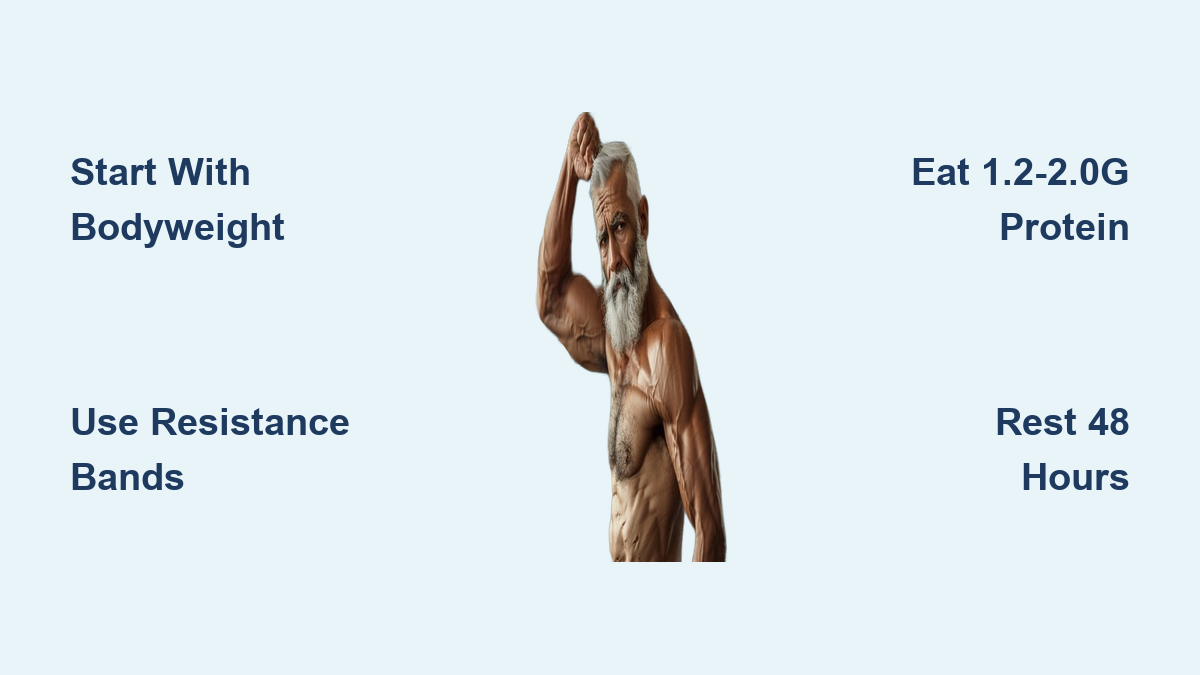
You’re never too old to build muscle. In fact, after age 60, gaining strength isn’t just beneficial, it’s essential for staying independent, mobile, and healthy. Despite common myths, research confirms that seniors in their 70s, 80s, and beyond can build muscle with the right approach. The key lies in combining targeted resistance training, optimal protein intake, and consistent recovery habits.
This guide delivers a science-backed, step-by-step plan tailored for seniors. You’ll learn safe, effective exercises, how much protein to eat, and how to recover properly. Whether you’re starting from zero or resuming fitness, these strategies are designed for real life, real bodies, and lasting results.
Start Resistance Training Safely

Building muscle begins with resistance. Contrary to myth, strength training isn’t risky for seniors, it’s protective. It strengthens bones, stabilizes joints, and improves balance. The goal isn’t bodybuilding, it’s functional strength for daily tasks like carrying groceries or standing from a chair.
Choose Low-Impact Strength Exercises
Begin with movements that build confidence and control. Low-impact options reduce joint strain while still stimulating muscle growth.
• Chair squats: Stand from a seated position using only your legs. Keep your back straight and knees over toes. Start with 10 reps, 2 sets.
• Wall push-ups: Stand arm’s length from a wall, place hands on it, and perform slow push-ups. Progress by stepping further back.
• Seated leg extensions: Sit tall, extend one leg, hold for 2 seconds, then lower. Builds quadriceps safely.
• Standing knee lifts: Alternate lifting knees to hip height. Improves hip strength and balance.
These exercises require no equipment and can be done at home. Use a sturdy chair or wall for support if needed.
Use Resistance Bands for Progressive Overload
Resistance bands are ideal for seniors. They’re portable, affordable, and offer adjustable tension to match your strength level.
Try these beginner-friendly moves:
• Band rows: Step on the band, pull handles toward your ribs, squeezing shoulder blades.
• Band chest press: Anchor band behind you, press forward at chest height.
• Band lateral raises: Press arms out to the sides, targeting shoulders.
Start with light resistance (yellow or red bands), 10 to 12 reps per set, 2 sets. Gradually increase tension as movements feel easier.
Progress to Light Weights and Machines
Once bodyweight and bands feel comfortable, introduce light dumbbells (2 to 5 lbs) or machines.
• Machine-based training (e.g., leg press, chest press) offers stability and reduces injury risk.
• Dumbbell shoulder press: Sit upright, press weights overhead with control.
• Farmer’s carry: Walk 10 to 15 steps holding light weights. Boosts grip, core, and posture.
Focus on form, not weight. Controlled movements build muscle more effectively than heavy lifting with poor technique.
Follow a Senior-Specific Workout Routine
A structured plan ensures you train all major muscle groups safely and consistently. This full-body routine takes 30 to 45 minutes and can be done twice weekly.
Warm Up for 5 to 10 Minutes
Never skip warm-up. It prepares muscles, improves circulation, and reduces injury risk.
• March in place: 1 minute
• Arm circles: Forward and backward, 30 seconds each
• Mini squats with arm raise: 10 reps, inhale down, exhale up
• Side steps with arm swings: 1 minute
Perform Full-Body Exercises
Complete 2 sets of 10 to 12 reps for each movement. Rest 30 to 60 seconds between sets.
Lower Body
• Step-back lunge: Step one foot back, lower knee toward floor, return to start.
• Farmer’s carry: Walk with light dumbbells, engaging core.
Upper Body
• Seated shoulder press: 2 to 5 lb dumbbells, press overhead.
• Bent-over row: Hinge at hips, pull weights to ribs, squeeze back.
• Biceps curl: Slow, controlled lift and lower.
• Triceps extension: One dumbbell overhead, lower behind head.
Core and Stability
• Standing knee-to-elbow: Twist slightly, bring knee and elbow together.
• Standing figure-eight: Hold a light weight, trace figure-eight in front of body.
• Single-leg stand: Hold 15 to 30 seconds per leg, use wall if needed.
Cool Down and Stretch
End with 5 to 10 minutes of stretching to improve flexibility and reduce soreness.
• Shoulder stretch: Pull one arm across chest, hold 20 seconds.
• Hamstring stretch: Lie on back, lift one leg, reach toward toes.
• Neck rolls: Slow, gentle circles to release tension.
• Deep breathing: Inhale through nose, exhale fully, promoting relaxation.
Optimize Protein Intake for Muscle Growth

Protein is the building block of muscle. But older adults need more than the standard recommendation due to anabolic resistance, a reduced ability to turn protein into muscle.
Eat 1.2 to 2.0 Grams of Protein Per Kilogram
For a 154 lb (70 kg) senior, that’s 84 to 140 grams daily, nearly double the standard guideline.
Spread intake across meals:
• Breakfast: 2 eggs plus Greek yogurt equals about 25g
• Lunch: Grilled chicken salad equals about 30g
• Dinner: Baked salmon plus quinoa equals about 35g
• Snack: Cottage cheese or protein shake equals about 20g
This even distribution boosts muscle protein synthesis better than loading protein at dinner.
Prioritize High-Quality Protein Sources
Not all protein is equal. Animal-based sources are more effective due to higher leucine, an amino acid that triggers muscle growth.
Best options
• Eggs, Greek yogurt, cottage cheese
• Chicken, turkey, lean beef
• Fish (salmon, tuna, cod)
• Milk or whey protein
Plant-based alternatives
• Tofu, tempeh, edamame
• Lentils, chickpeas, beans
• Nuts, seeds (almonds, chia)
Combine plant proteins (e.g., rice plus beans) to ensure complete amino acid profiles.
Consider Muscle-Boosting Supplements
Under medical guidance, these can enhance results:
• Whey protein: 20 to 30g post-workout. Fast-absorbing and rich in leucine.
• Creatine monohydrate: 3 to 5g daily. Proven to increase strength and lean mass in seniors.
• Omega-3s: 1 to 2g fish oil. Reduces inflammation and may improve muscle response.
• Vitamin D3: 800 to 1000 IU if deficient. Supports muscle function and fall prevention.
Support Recovery With Sleep and Rest
Muscles grow during rest, not workouts. Recovery is non-negotiable for progress and injury prevention.
Sleep 7 to 9 Hours Nightly
During deep sleep, your body releases growth hormone and IGF-1, which repair muscle tissue. Poor sleep raises cortisol, a hormone that breaks down muscle.
Improve sleep quality
• Go to bed and wake at the same time daily.
• Avoid screens 1 hour before bed.
• Limit caffeine after 2 PM.
• Keep bedroom cool and dark.
Allow 48 Hours Between Muscle Workouts
Don’t train the same group two days in a row. For example:
• Monday: Full-body strength
• Tuesday: Walking or stretching
• Wednesday: Rest or light activity
• Thursday: Repeat strength session
This rest window prevents overtraining and supports adaptation.
Stay Hydrated Throughout the Day
Dehydration causes cramps, fatigue, and dizziness, especially dangerous during exercise.
• Drink 6 to 8 glasses (1.5 to 2L) of water daily.
• Sip before, during, and after workouts.
• Monitor urine color: pale yellow means you’re hydrated.
Prevent Injury With Proper Form and Prep
Safety comes first. A single fall or strain can derail progress. These steps minimize risk.
Warm Up Before Every Session
A 5 to 10 minute warm-up increases blood flow and prepares joints.
• Dynamic movements only: Avoid static stretching before lifting.
• Focus on muscles you’ll use, e.g., leg swings before lower-body work.
Use Support for Balance-Sensitive Moves
• Hold a chair during single-leg stands or lunges.
• Perform wall push-ups instead of floor versions.
• Sit during upper-body exercises if standing causes dizziness.
Breathe and Brace Correctly
• Exhale during exertion (e.g., when standing from a chair or lifting a weight).
• Inhale during the return phase.
• Keep your core engaged to protect your spine.
Address Common Senior Concerns
Many older adults hesitate to start strength training. Here’s how to overcome common barriers.
I’m Too Old to Start
False. Studies show adults aged 60 to 86 gain strength after just 6 months of training. One trial found participants improved leg press strength by 35% and triceps size by 20%. Age isn’t a limit, consistency is.
I’m Afraid of Getting Hurt
Risk is low with proper form and gradual progression. Start with chair-based or band exercises. Use support when needed. The real danger is inactivity, it increases fall and fracture risk.
I Have Arthritis or Limited Mobility
Adapt, don’t avoid. Try:
• Seated versions of squats, presses, and leg lifts.
• Range-of-motion exercises if strength is limited.
• Water aerobics for low-impact resistance.
Work with a physical therapist to tailor exercises to your condition.
Stay Motivated and Track Progress
Long-term success depends on consistency. Use these strategies to stay on track.
Set Realistic, Measurable Goals
Start small:
• “I’ll do 2 strength sessions this week.”
• “I’ll add 1 more rep to my squats.”
Track improvements:
• Time how long you can hold a single-leg stand.
• Note how easily you rise from a chair.
• Record weights used and reps completed.
Join a Class or Workout With a Friend
Social support boosts adherence. Many community centers offer senior fitness classes. Walking clubs or group resistance sessions make exercise enjoyable.
Use Technology to Stay on Track
• Fitness trackers (Fitbit, Apple Watch) monitor steps, heart rate, and activity.
• Apps like MyFitnessPal help log protein intake.
• Set phone reminders for workout times.
Frequently Asked Questions About Building Muscle for Elderly
Can You Actually Build Muscle After 60?
Yes. Research consistently shows that adults in their 60s, 70s, and beyond can gain significant muscle mass and strength. The key is consistent resistance training combined with adequate protein intake. While muscle protein synthesis slows with age, it remains responsive to exercise and proper nutrition.
How Much Protein Do Seniors Need to Build Muscle?
Seniors need 1.2 to 2.0 grams of protein per kilogram of body weight daily. For a 154 lb (70 kg) person, that’s 84 to 140 grams. This is nearly double the standard adult recommendation due to anabolic resistance, which reduces the body’s efficiency at converting protein into muscle.
What Is the Best Exercise for Elderly to Build Muscle?
The best exercises combine low-impact resistance training with functional movements. Chair squats, wall push-ups, resistance band exercises, and light dumbbell work are ideal starting points. These exercises build strength while minimizing joint strain and fall risk.
How Often Should Seniors Lift Weights?
Seniors should perform strength training 2 to 4 days per week, with at least 48 hours of rest between working the same muscle groups. A full-body routine twice weekly is effective and manageable for most older adults.
Is It Safe for Seniors to Lift Weights?
Yes, when done properly. Low-impact resistance training is safe and beneficial for seniors. The real risk comes from inactivity. Start with bodyweight exercises, use support for balance, focus on form, and progress gradually. Consult a doctor before beginning any new exercise program.
What Prevents Muscle Growth in Older Adults?
Several factors can hinder muscle growth in seniors, including inadequate protein intake, poor sleep, dehydration, and sedentary lifestyle. Anabolic resistance (reduced muscle protein synthesis) also plays a role, which is why higher protein intake is necessary. Addressing these factors maximizes muscle-building potential.
Key Takeaways for Senior Muscle Building

Building muscle after 60 isn’t only possible, it’s one of the best investments you can make in your health. The formula is simple but powerful.
Train smart: Aim for 2 to 4 days per week with resistance exercises. Start with bodyweight or band exercises and progress gradually. Focus on form over weight.
Eat right: Consume 1.2 to 2.0g/kg protein daily, spread across 3 to 4 meals. Prioritize high-quality sources like eggs, fish, chicken, and dairy. Consider whey protein or creatine supplements under medical guidance.
Recover properly: Sleep 7 to 9 hours nightly, stay hydrated with 6 to 8 glasses of water daily, and allow 48 hours between workouts for the same muscle groups.
Prioritize safety: Always warm up before exercise, use support for balance-sensitive moves, and consult your doctor before starting, especially with existing health conditions.
You don’t need a gym or expensive equipment. A chair, resistance band, and pair of light dumbbells are enough to begin. The goal isn’t perfection, it’s progress. Each squat, each rep, each healthy meal builds resilience. Your stronger, more independent future starts today.