Walking on a treadmill is one of the safest and most effective ways for seniors to stay active, improve heart health, and maintain independence. For older adults managing arthritis, balance issues, or chronic conditions like diabetes and hypertension, knowing how to use a treadmill for seniors properly can mean the difference between injury and lasting wellness. This guide delivers a complete, step-by-step approach to safe, sustainable treadmill use tailored specifically for adults over 60.
Choosing the Right Treadmill for Senior Safety

Picking a treadmill designed for senior needs ensures safety, comfort, and long-term use. Not all models are suitable for older adults, especially those with joint pain, limited mobility, or balance concerns.
Key Features to Look For
The ideal treadmill for seniors includes several important specifications that prioritize safety and ease of use.
• Low starting speed between 0.5 to 1.0 mph allows gentle initiation for beginners or those recovering strength.
• Wide, cushioned deck measuring 16 to 20 inches wide and 50 to 60 inches long reduces joint impact and provides stability.
• Shock-absorbing surface technology protects knees and hips from excessive stress.
• Sturdy handrails and safety clip are essential for mounting, dismounting, and emergency stops.
• Simple console with large display avoids cluttered interfaces and prioritizes clear, readable metrics.
• Quiet motor between 2.0 to 2.5 CHP minimizes noise, especially important in small living spaces.
• Foldable design saves space in apartments or shared homes.
• Weight capacity of 300 to 400 lbs ensures the machine handles the user safely.
Manual vs. Electric Treadmills
Electric treadmills suit most seniors because they offer smooth start and stop functions, adjustable speed and incline control, and built-in workout programs. The downside is they require power, cost more, and need more maintenance.
Curved or manual treadmills work well for active seniors interested in strength training. These models need no electricity, encourage natural gait mechanics, and allow barefoot walking. However, they have a steeper learning curve and require more initial effort to start moving.
Example: The Tousains ENT-T250 offers a 0.6 mph start speed, app connectivity, and folding frame, making it ideal for small spaces. The Aussie Pro Runner curved treadmill supports barefoot walking and builds power without a motor.
Essential Safety Steps Before Your First Workout
Proper preparation prevents injury and sets the foundation for a successful workout. Taking these steps seriously protects your health from the very beginning.
Get Medical Clearance First
Consult your doctor before starting any treadmill program, especially if you have heart disease, diabetes, high blood pressure, joint pain or arthritis, or balance disorders like Parkinson’s. Those recovering from surgery or stroke may need physical therapy guidance. High-risk individuals with a history of falls or frailty should consider supervised sessions.
Wear the Right Gear
Proper footwear is critical for safety and performance. Use supportive walking or athletic shoes with good cushioning and grip. Replace shoes every 300 to 500 miles to maintain shock absorption. Choose breathable, moisture-wicking fabrics for clothing and avoid loose pants or dangling accessories that could catch in the belt. Consider using a heart rate monitor with handrail sensors or a chest strap to track exertion safely.
Hydrate and Fuel Properly
Drink water before and after your session to stay hydrated. Avoid exercising on a full stomach by waiting 1 to 2 hours after meals. Eat a light snack like a banana or yogurt if energy is low before walking.
Safe Mounting and Dismounting Techniques
One of the highest fall risks occurs when getting on or off the treadmill. Following proper technique every time protects you from injury.
How to Mount Safely
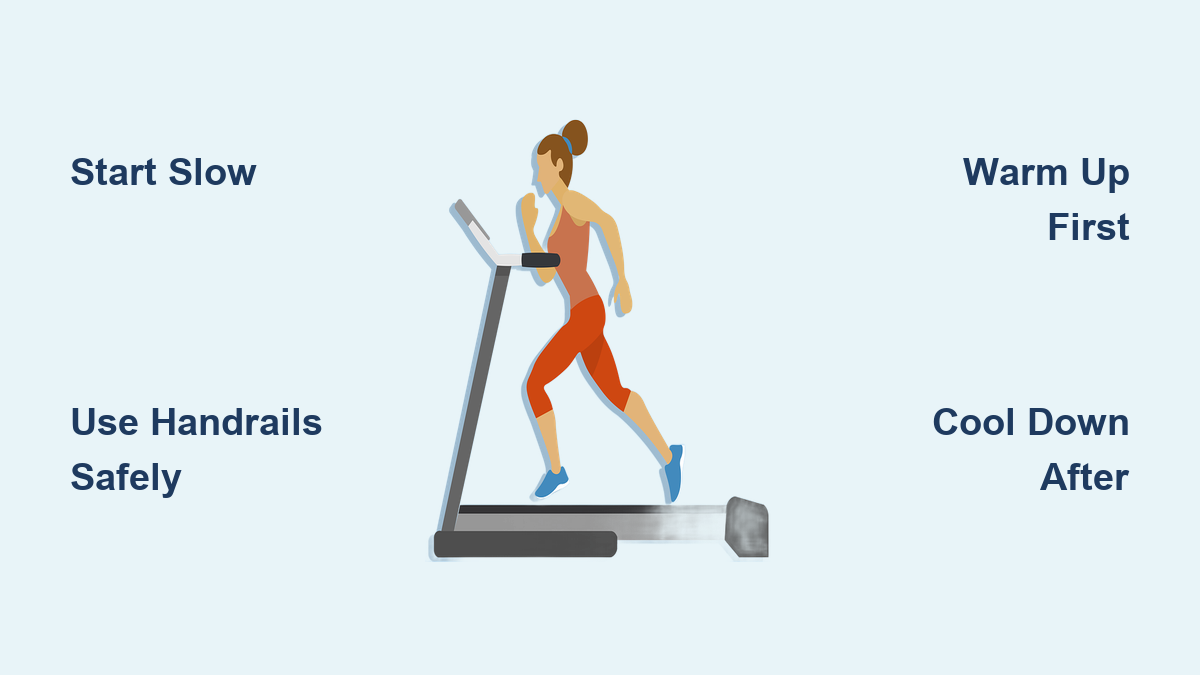
Place the safety clip on your shirt before starting. Stand on the side decks, which are the non-moving parts of the treadmill. Hold both handrails firmly. Start the treadmill at 0.5 to 1.0 mph. Step one foot onto the moving belt, then the other foot. Begin walking slowly once both feet are on.
How to Dismount Safely
Gradually reduce speed to 0.5 mph. Wait until the belt stops completely before stepping off. Step off backward first, then forward. Never jump off the treadmill. Remove the safety key only after the belt has fully stopped.
Warning: Never mount or dismount while the treadmill is at full speed. Always pause or stop first to prevent falls.
Proper Warm-Up Routine for Older Adults
Skipping warm-up increases the risk of dizziness, joint strain, and cardiovascular stress. A proper warm-up prepares your body for the workout ahead.
5-Minute Warm-Up Procedure
Set your speed between 1.0 and 2.0 mph with zero incline. Walk tall with shoulders back and chin parallel to the floor. Let your arms swing naturally. Breathe rhythmically through your nose. If balance is a concern, lightly hold the handrails for support during warm-up.
Tip: Less active seniors may need to extend warm-up to 10 minutes. Listen to your body and adjust accordingly.
Walking with Correct Form and Posture

Good posture prevents injury and maximizes the health benefits of your workout. Focus on these elements with every step.
Posture and Alignment
Keep your head up with chin parallel to the floor and look forward across the room. Maintain an upright spine with the natural curve in your lower back. Roll your shoulders back and down to open your chest. Bend elbows at 90 degrees and swing arms opposite to your legs. Point your hands forward, aligned with the console.
Foot and Stride Mechanics
Land heel-first and roll through to toe-off for a smooth gait. Push off with the entire foot to engage calves and glutes. Keep steps short and controlled. Avoid overstriding, which causes knee strain. Lengthen your stride by engaging your glutes rather than increasing step count.
Handrail Use: When and How
Use handrails only to mount and dismount or during balance drills. Holding them constantly reduces arm swing, weakens core engagement, and promotes poor posture. Practice 30-second hand releases by letting go with one hand, then switching sides.
Pro Tip: Place your tablet or TV at eye level so you don’t tilt your head down and disrupt spinal alignment.
Breathing Techniques for Treadmill Walking
Efficient breathing boosts endurance and reduces fatigue during your workout. Your breathing pattern should match your intensity level.
At low intensity, breathe in through your nose and out through your nose. At moderate intensity, inhale through your nose and exhale through your mouth. Use belly breathing by expanding your abdomen on the inhale and contracting on the exhale. Try pacing your breath with 3 steps to inhale and 2 steps to exhale. If you start gasping, slow down because your pace is too high.
Structured Workout Plans for Seniors
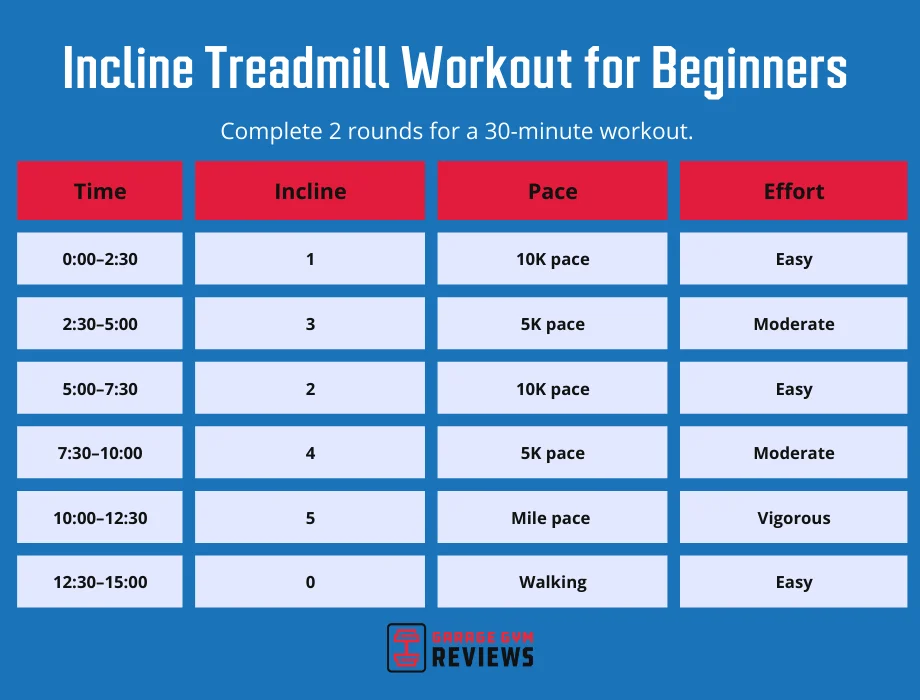
A complete session includes warm-up, main workout, cool-down, and stretching. Choose a workout type that matches your fitness level and goals.
Steady-State Walking for Beginners
Maintain a speed of 2.0 to 3.1 mph for 10 to 20 minutes with 0 to 1% incline. The goal is to maintain a pace where you can talk comfortably. This builds endurance and improves circulation.
Interval Walking for Cardio Boost
Alternate every 2 minutes between easy pace at 2.0 to 2.5 mph and brisk pace at 3.0 to 3.5 mph. Repeat this pattern for 20 minutes total. To progress, increase the brisk intervals or reduce recovery time.
Incline Walking for Leg Strength
Set incline between 2 and 5% starting low. Walk at 2.0 to 3.0 mph for 5 to 10 minutes. Lean slightly forward from your ankles and engage your glutes. Avoid bending at the waist.
Backward Walking for Balance
Walk at 1.0 to 2.0 mph for 3 to 5 minutes. Face the console and hold handrails securely. Walk backward slowly and with control. This strengthens shin muscles and improves proprioception.
Side Stepping for Hip Stability
Move at 1.0 to 1.5 mph for 3 minutes per side. Hold handrails and step sideways, then bring your trailing foot to meet it. This builds hip abductors and enhances balance.
Cooling Down and Stretching After Walking
Never stop abruptly because cooling down prevents dizziness and muscle stiffness. This phase is just as important as the workout itself.
5-Minute Cool-Down
Gradually reduce speed to 1.0 mph. Walk slowly for 5 minutes. Monitor your heart rate until it drops below 100 beats per minute.
Post-Workout Stretching
Hold each stretch for 15 to 30 seconds without bouncing. Stretch your calves by placing hands on a wall and one leg back with heel down. Stretch hamstrings by sitting on a chair edge and extending one leg while reaching toward toes. Stretch quadriceps by standing and holding your ankle behind you. Perform hip flexor stretches in a low lunge position. Include shoulder rolls forward and backward and arm crosses pulling one arm across your chest.
Tip: Stretch while muscles are still warm for the best results.
Tracking Progress and Advancing Safely
Consistent tracking keeps you motivated and helps prevent plateaus in your fitness journey.
Using the RPE Scale
Rate your effort from 1 to 10. Levels 1 to 3 mean very light with easy breathing. Levels 4 to 6 mean moderate where you can talk. Levels 7 to 8 mean challenging where you cannot sing. Levels 9 to 10 mean maximum effort. Aim for 4 to 6 during most workouts.
Weekly Progression Tips
Increase speed by 0.1 to 0.3 mph per week. Add 1% incline weekly until reaching 5 to 6%. Extend duration by 2 to 5 minutes weekly. Track speed, incline, time, heart rate, RPE, and distance.
Finding Your Sweet Spot Pace
This is your optimal walking speed that is challenging but sustainable. Examples include 4.0, 4.5, or 5.0 mph. Record it and aim to maintain or improve over time.
Common Mistakes to Avoid
Even small errors can reduce benefits or increase injury risk. Steer clear of these frequent problems.
Holding Handrails Constantly
This causes poor posture, reduces arm swing, and weakens balance training. Use handrails only for mounting or balance checks.
Overstriding
This causes knee strain and inefficient gait. Take shorter steps and focus on heel-to-toe rolling.
Skipping Warm-Up or Cool-Down
This leads to dizziness, muscle soreness, and cardiovascular strain. Always include both phases in every session.
Increasing Too Fast
This causes joint pain and burnout. Progress gradually because consistency beats intensity.
Ignoring Pain or Dizziness
This risks injury or medical emergency. Stop immediately if you feel chest pain, severe shortness of breath, dizziness, joint pain, or irregular heartbeat.
Special Considerations for Health Conditions
Tailor your routine to your specific health situation for the safest and most effective results.
Arthritis and Joint Pain
Use a treadmill with a cushioned deck. Walk at low to moderate speeds. Avoid high-impact activities like jogging unless approved by your doctor. Warm up longer at 8 to 10 minutes to loosen stiff joints.
Balance and Fall Risk
Use handrails during backward or side stepping exercises. Practice one-foot-on drills by alternating placing one foot on the belt while holding rails. Stop immediately if you feel unsteady.
Diabetes and Blood Sugar
Exercise helps regulate glucose, which is ideal for type 2 diabetes. Check blood sugar before and after exercise if you use insulin. Carry a fast-acting carb like a glucose tablet in case of hypoglycemia.
Barefoot Training
This is possible only on manual curved treadmills. It improves foot strength and natural gait. Use toe spacers if feet feel tight from narrow shoes.
Weekly Routine for Senior Treadmill Training
Use this sample schedule as a starting point and adjust based on your fitness level.
| Day | Workout | Duration | Notes |
|---|---|---|---|
| Monday | Interval Walk | 20 min | 2-min easy, 2-min brisk |
| Tuesday | Rest or Stretch | — | Light mobility work |
| Wednesday | Incline + Side Steps | 25 min | 5% incline, 3 min per side |
| Thursday | Forward + Backward Walk | 20 min | 15 min forward, 5 min backward |
| Friday | Endurance Walk | 30 min | At sweet spot pace |
| Saturday | Balance + Stretch | 15 min | Off-treadmill drills |
| Sunday | Rest | — | Full recovery |
Adjustments: Beginners should start with 3 days per week and 15 minutes. Active seniors can add a 6th day or increase intensity.
Frequently Asked Questions About Using Treadmills for Seniors
What is a safe starting speed for seniors on a treadmill?
Start at 0.5 to 1.0 mph. This slow speed allows you to get comfortable with the belt movement before increasing pace. Many treadmills designed for seniors offer specific walking modes that begin at 0.6 mph.
How long should a senior walk on the treadmill initially?
Begin with 10 to 15 minute sessions including warm-up and cool-down. Gradually increase duration by 2 to 5 minutes weekly until reaching 20 to 30 minutes total.
Is treadmill walking safe for seniors with arthritis?
Yes, treadmill walking is safe and beneficial for seniors with arthritis. Choose a model with a cushioned deck and shock absorption. Keep speeds low to moderate and warm up longer to loosen stiff joints.
Can seniors use treadmills for balance training?
Yes, treadmills help improve balance when used properly. Practice backward walking and side stepping while holding handrails. Perform one-foot-on drills to challenge balance safely.
Should seniors hold the handrails while walking on a treadmill?
Use handrails only for mounting, dismounting, or brief balance checks. Holding them constantly promotes poor posture and reduces the balance-building benefits of walking.
Key Takeaways for Safe Senior Treadmill Use
Using a treadmill safely and effectively empowers seniors to live stronger, longer, and more independently. Start slow by beginning with 10 to 15 minute sessions at low speeds. Be consistent because 3 to 5 days per week matters more than pushing hard once. Listen to your body because pain is a warning sign that should never be ignored. Combine treadmill walking with strength training 2 to 3 times weekly for full-body fitness. Make it enjoyable by listening to music, audiobooks, or watching shows while you walk.
“A healthy body equals a healthy mind.” — Paul Centonze, age 67, former 52% disability, now active senior athlete.
With the right knowledge, tools, and mindset, walking on a treadmill is more than exercise. It is a lifelong habit that keeps you moving forward and maintaining your independence for years to come.