

If you’re over 50 and tired of switching between reading glasses and distance specs, you might wonder: does LASIK work for seniors? The answer isn’t a simple yes or no. While LASIK can successfully improve vision in older adults, its long-term effectiveness depends more on eye health than age. The FDA doesn’t set an upper age limit for LASIK, but age-related changes like presbyopia, cataracts, and dry eyes significantly impact results. For many seniors, LASIK offers freedom from glasses for distance vision, but it won’t stop the natural aging of the eye. Success hinges on realistic expectations, thorough pre-op screening, and understanding alternatives that may offer more lasting benefits.
This guide breaks down who makes a good candidate, how aging affects outcomes, and what options truly deliver long-term independence from glasses.
Age-Related Vision Changes Affecting LASIK
:max_bytes(150000):strip_icc()/VWH-Presbyopia-How-Aging-Affects-Your-Vision-TEXT-FINAL-1-1-5d3c0e9f966443ef94194f82f0743498.png)
Presbyopia Progression
After age 40, the eye’s lens stiffens, making it harder to focus on close objects. This condition, called presbyopia, progresses regardless of whether you’ve had LASIK. The procedure reshapes the cornea but cannot reverse lens hardening. Even with perfect distance vision post-surgery, most seniors will still need reading glasses for fine print, smartphone use, and close-up tasks. This is a core limitation: LASIK corrects refractive errors, not aging biology.
Early Cataract Development
By age 60+, many people develop early cataracts, which cloud the natural lens. LASIK doesn’t prevent or treat cataracts. Operating on eyes with existing lens opacity may yield only temporary improvement. Worse, prior LASIK complicates future cataract surgery by affecting intraocular lens power calculations. If cataracts are already forming, lens-based procedures like Refractive Lens Exchange may be smarter than corneal surgery.
Chronic Dry Eye Risk
Seniors, especially postmenopausal women, often suffer from dry eye due to reduced tear production. LASIK temporarily disrupts corneal nerves that trigger tear reflexes, worsening dryness. While younger patients usually recover in 3-6 months, seniors may experience prolonged symptoms requiring artificial tears, anti-inflammatory drops, or punctal plugs. Severe dry eye can disqualify LASIK candidacy altogether.
Other Ocular Health Factors
Glaucoma, macular degeneration, diabetic retinopathy, and corneal thinning all influence eligibility. These conditions don’t automatically rule out surgery but require careful evaluation. Glaucoma patients need stable intraocular pressure, and those with AMD may see limited benefit even after perfect LASIK correction.
LASIK Candidacy Criteria for Older Adults
Vision Stability and Prescription
Your glasses or contact lens prescription must be stable for at least 12 months. Fluctuating vision, common with uncontrolled diabetes or hormonal shifts, increases risk of under-correction or over-correction. Seniors should confirm stability through consistent eye exams before considering surgery.
Corneal Thickness and Shape
Adequate corneal thickness is essential for safe flap creation and tissue removal. Thin corneas increase risk of ectasia, especially in older eyes with reduced structural resilience. Topography and tomography scans detect irregularities like keratoconus that could disqualify candidacy.
Tear Film Quality
A healthy tear film ensures proper healing and comfort. Tests like Schirmer’s, tear osmolarity, and meibography assess dry eye severity. Mild cases may proceed with precautions, while moderate to severe dry eye often leads surgeons to recommend PRK or delay surgery.
Lens Clarity and Retinal Health
A clear natural lens and healthy retina are non-negotiable requirements. Slit-lamp exams rule out cataracts, while dilated fundus exams check for macular issues or diabetic damage. If retinal disease is present, visual gains from LASIK may be minimal.
Monovision LASIK: A Practical Compromise
How Blended Vision Works
Monovision LASIK corrects one eye, usually the dominant one, for distance and leaves the other slightly nearsighted for reading. The brain blends input from both eyes, allowing functional vision at multiple distances. It’s not perfect, as neither eye sees crisply at both near and far ranges, but it reduces reliance on reading glasses.
Who Benefits Most
Ideal candidates for monovision LASIK include adults ages 40-70 who have already used monovision with contact lenses successfully. Those with active lifestyles, including travelers, swimmers, and hobbyists, often benefit most. You should be willing to trade some depth perception for spectacle independence. Success rates are high, with 85-90% reporting satisfaction, but adaptation varies. Some struggle with night driving or fine detail tasks.
Test Before You Commit
Always trial monovision with contact lenses first. Spend a week or two simulating the effect. If you can’t adapt to blurry vision in one eye, surgery likely won’t help. This simple test prevents costly regrets.
Alternative Procedures for Lasting Results
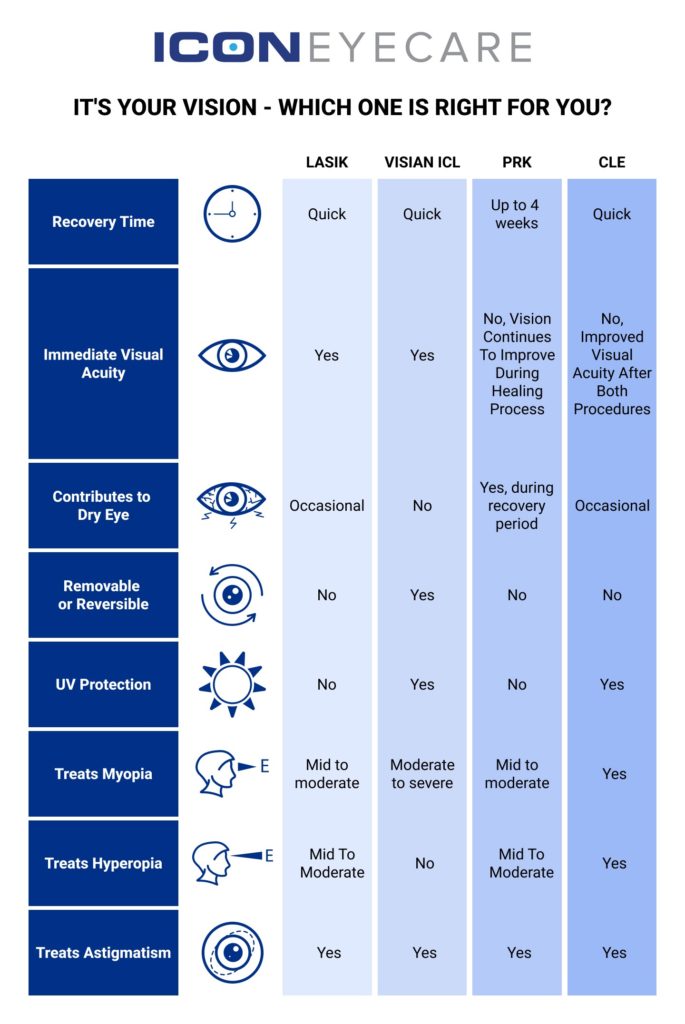
Refractive Lens Exchange (RLE)
RLE removes the aging lens and replaces it with a premium intraocular lens, similar to cataract surgery but done proactively. It’s often a better long-term solution than LASIK for seniors over 50.
Benefits include correcting presbyopia with multifocal or EDOF lenses, preventing future cataracts, providing stable vision unaffected by lens aging, and achieving over 90% spectacle independence. IOL options include multifocal lenses for clear vision at near, intermediate, and far distances, EDOF lenses for smooth transition across distances with fewer halos, toric lenses for astigmatism correction, and light-adjustable lenses that can be fine-tuned post-op with UV light, which is ideal for prior LASIK patients. RLE costs more, typically $3,000-$5,000 per eye, and has a longer recovery, but offers comprehensive correction LASIK cannot match.
Implantable Collamer Lens (ICL)
ICL inserts a corrective lens inside the eye without removing the natural one. It’s best for younger presbyopes ages 40-50 with high myopia or thin corneas.
Advantages include being reversible, offering excellent optics, and treating extreme prescriptions up to -20 diopters. However, for seniors, ICL doesn’t stop presbyopia or cataracts, requires lifelong monitoring, and becomes less ideal after age 50 due to advancing lens aging.
PRK: Flap-Free Alternative
PRK reshapes the cornea without creating a flap, making it better for patients with dry eyes or thin corneas.
Advantages include no flap complications, safer for active lifestyles, and suitability when LASIK isn’t an option. Downsides include slower recovery lasting 1-4 weeks, more discomfort during healing, and higher risk of haze, though this is reduced with mitomycin C application. PRK is often chosen when LASIK is too risky due to corneal anatomy.
Risks and Side Effects in Older Patients
Persistent Dry Eyes
Dry eyes are more common and longer-lasting in seniors. Management may require preservative-free artificial tears, cyclosporine or lifitegrast anti-inflammatory drops, and punctal plugs to conserve natural tears.
Night Vision Disturbances
Glare, halos, and starbursts occur especially with large pupils or high corrections. Topography-guided LASIK reduces these risks by customizing treatment to each patient’s corneal shape.
Fluctuating or Blurry Vision
Temporary blurriness during healing may last longer in older adults. Full stabilization can take weeks rather than days.
Need for Enhancement
Under-correction or over-correction occurs in 5-10% of cases. Enhancement procedures are possible if enough corneal tissue remains.
LASIK vs. Alternatives: Which Is Best?

| Feature | LASIK | Monovision LASIK | RLE | ICL | PRK |
|---|---|---|---|---|---|
| Corrects Presbyopia? | No | Partially | Yes | No | No |
| Treats High Myopia? | Limited | Same | Yes | Yes | Limited |
| Reversible? | No | Yes | No | Yes | No |
| Prevents Cataracts? | No | No | Yes | No | No |
| Best Age Range | 18-40 | 40-60 | 50+ | 21-45 | All ages |
| Recovery Time | 1-2 days | 1-2 days | 1-2 weeks | 1-2 weeks | 1-4 weeks |
| Dry Eye Risk | Moderate | Same | Low | Low | Moderate |
| Cost per Eye | $2,000-$3,000 | $2,000-$3,000 | $3,000-$5,000 | $4,000-$5,500 | $2,000-$3,000 |
LASIK is less invasive and cheaper, but RLE offers more complete, future-proof vision correction for those over 50.
Real-World Outcomes and Satisfaction
Success Rates
LASIK achieves 95% of patients reaching 20/40 or better, with 90% achieving 20/20 vision. Monovision LASIK helps 85-90% reduce glasses use. RLE with premium IOLs delivers over 90% achieving spectacle independence. ICL helps over 99% reach 20/40 or better.
Long-Term Feedback
LASIK patients over 40 often love initial freedom from distance glasses but grow frustrated as presbyopia worsens over time. RLE patients report higher long-term satisfaction due to full-range vision and no future cataract worries. Monovision users appreciate convenience but may still need readers for small print or night driving.
Lifestyle Impact
Seniors value independence whether for hiking, reading, or driving. LASIK helps with distance vision, but only RLE or premium IOLs eliminate both distance and near-vision dependence.
Professional Guidance: What Surgeons Recommend
When LASIK Is a Good Fit
LASIK works well for seniors with stable prescriptions, healthy corneas and tear film, no cataracts or retinal disease, and who accept needing reading glasses afterward. It’s ideal for those who prefer quick recovery and minimal downtime and who have successfully tried monovision with contacts.
When to Choose RLE Instead
RLE is better when early cataracts or high cataract risk exists, when complete glasses independence is desired, when over 55 with progressive presbyopia, when dealing with high refractive error or thin corneas, and when willing to invest in a long-term solution.
Must-Have Pre-Op Tests
Essential pre-operative tests include corneal topography and tomography, pachymetry for thickness measurement, tear film analysis, wavefront aberrometry for custom treatment, dominant eye testing for monovision planning, and IOL calculations if RLE is being considered.
Frequently Asked Questions About LASIK for Seniors
Is LASIK safe after 60?
Yes, if your eyes are healthy. Age alone doesn’t disqualify you. Safety depends on corneal thickness, lens clarity, and absence of glaucoma or macular disease.
Can I get LASIK after cataract surgery?
Yes. LASIK or PRK can correct residual refractive error post-cataract surgery. This is called laser enhancement and is common for fine-tuning vision.
Will I still need reading glasses?
With standard LASIK, yes. With monovision or RLE using multifocal IOLs, many eliminate reading glasses entirely.
Does LASIK prevent cataracts?
No. Only lens removal procedures like RLE or cataract surgery prevent cataracts. LASIK affects only the cornea.
How do I know if I qualify?
A full eye exam by a refractive specialist is required. They’ll check corneal health, prescription stability, dry eye severity, and retinal status.
Are results permanent?
LASIK’s corneal change is permanent, but presbyopia and cataracts will still develop. Vision may shift over time, requiring future correction.
Is recovery slower for seniors?
Healing may take slightly longer, especially for dry eye resolution. Most resume normal activities in 1-2 days, but full visual stabilization can take weeks.
Final Thoughts on LASIK for Seniors
LASIK can work for seniors, but it’s not always the best long-term solution. The key is understanding that age-related eye changes like presbyopia and cataract development continue regardless of LASIK outcomes. While LASIK successfully corrects distance vision for many older adults, it doesn’t address the underlying aging of the eye’s lens.
For those over 50 seeking complete vision correction, procedures like RLE with premium IOLs often provide more comprehensive, lasting benefits. These alternatives correct near vision, prevent future cataracts, and deliver stable results unaffected by lens aging.
The most important step is a personalized evaluation with an experienced surgeon who considers your specific eye health, lifestyle needs, and vision goals. With the right approach and realistic expectations, clearer vision at any age is truly within reach. Don’t let age deter you from exploring your options, but do go in with full understanding of what each procedure can and cannot deliver.